
The Secret in the Stomach: Why the Bass Wants What It Wants
A BBZ Educational Story by Bill Siemantel
I’ve been telling anglers for decades: You’re not the hunter. You’re the prey.
That’s the foundation of everything I teach in the Big Bass Zone. If you want to catch the biggest fish in the lake, you have to stop looking through human eyes and start looking through bass eyes. And sometimes—most of the time—the trick to seeing through a fish’s eyes is first to look into its stomach.
Because what’s down that fish’s throat tells you exactly what illusion you need to create.
The Backpack Secret I’ve Kept for Years
For years, I’ve had something in my back pocket that most anglers never think about.
I knew there was an influx of freshwater prawns—yes, freshwater shrimp—that had somehow found their way into our lakes, reservoirs, and streams across California. And this isn’t just a California thing. It’s happening in waterways all across the U.S.
Now, here’s where it gets interesting. A freshwater prawn is a shrimp, sure—but to a bass, it also mimics and sort of looks like a crawdad. Same size range. Same bottom-dwelling behavior. Same protein punch. And bass? They don’t overthink it. They just know it’s food.
The thing is, freshwater prawns have become a massive forage source—especially pre-spawn through spawn. That’s why anglers have thrown jigs, jig-and-pigs, and pork trailers forever. Those lures imitated the profile of crawdads. But what if the fish is actually keying on something that looks like a crawdad but acts like a prawn?
That’s the gap nobody was filling.
The Science of the Strike: Building the Real McCoy
Enter FishLab Tackle—and their tagline that hooked me from day one: “The Science of the Strike.”
See, FishLab isn’t trying to build lures that trick fish. They’re designing lures so realistic that when a bass is hunting for specific prey, it knows it’s getting the real McCoy. The exact thing it’s feeding on at that exact moment.
That philosophy is everything I believe in.
So last year, I sat down with the FishLab team—myself, Mike Bennett, and HideIwasaki and we started dissecting this prawn-crawdad crossover.
What if we could build a lure that mimics both? A hybrid that has the illusion of a crawdad and a freshwater prawn, depending on how the bass is feeding during different times of year?
That’s how the FishLab Nature Series NEKO Flex Craw was born.
For The Non Believers
The Pyramid Lake Proof
Now, I’m usually the guy who keeps this stuff locked in the vault. These are the secrets that take years of being a student of the game to unlock. The keys that keep you consistent on catching more and bigger fish.
But recently, I went up to Pyramid Lake—one of my proving grounds—and I decided to let the cat out of the bag.
Every time I caught a fish, I showed my partner exactly what was down that bass’s throat. Shrimp. Prawns. Stuffed full of them. It was like the fish had been dining at an all-you-can-eat seafood buffet.
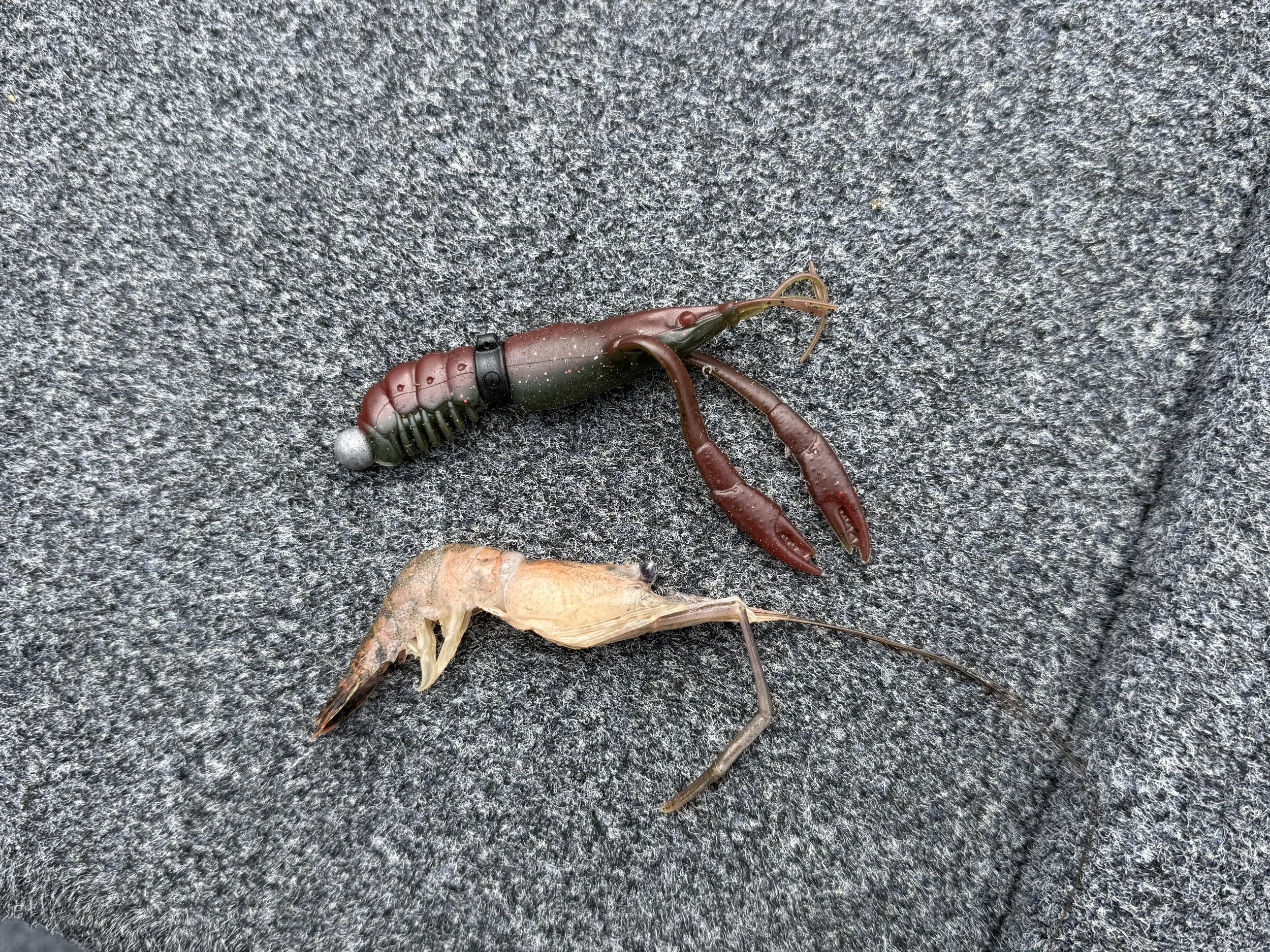
Then I caught a bass where you could literally see the shrimp down in its mouth. I pulled that prawn out, laid it side-by-side with the FishLab Nature Series Neko Flex Craw, and the match was undeniable.
Not close. Not “kind of similar.”
Undeniable.
That’s when it hit me—this wasn’t just a good lure. This was the ultimate illusion of realism. The bass weren’t being faked into something. They were accomplishing exactly what they wanted to do: eat the specific prey that was dominating their waterway at that specific time of year.
Why “Morning Dawn” and Pink Colors Actually Work
And here’s something I keyed into many years ago that I don’t think anybody’s ever really said out loud:
Why are certain colors so important?
Anglers ask all the time: “What the heck is a Morning Dawn color? Why pinks? Why light browns with blue veins?”
Everybody assumes those colors just represent sculpins and worms. But here’s the truth:
Those pinks, those light browns, those blue veins—they represent shrimp and prawns.
Morning Dawn colors don’t just imitate the bottom. They imitate the freshwater prawns and crawdads that bass are gorging on during the pre-spawn and spawn. The translucent pinks, the subtle blues running through the body—that’s the prawn profile in low light, in stained water, in the exact conditions where big bass feed most aggressively.
I’ve been fishing this color theory for years. Now I’m finally showing my hand.
The Tournament Proof
This isn’t theory. This is tournament-proven, video-documented reality.
I recently did a video up at Castaic—my old stomping grounds, where this whole BBZ journey started at the firehouse—catching almost 20 pounds on a prototype Neko Flex Craw. And my partner Tim and I have already won tournaments on this prototype bait.
When a lure wins tournaments before it even hits the market, you know you’ve got something special.
And the beauty is, it’s not just a bass thing. We’re talking big smallmouth, largemouth, spotted bass, catfish—everything eats crawdads and prawns. This crossover forage is the universal language of predatory fish.
The Bigger Picture: Prawns Are the Future of Forage
Here’s some science that backs up what I’ve been seeing on the water:
Freshwater prawns (Macrobrachium rosenbergii), also called giant river prawns, are tropical crustaceans native to the Indo-Pacific region—but they’ve been introduced to every continent except Antarctica for aquaculture and as supplemental forage
. In the U.S., they’re commercially farmed in the Midwest, the South, and Hawaii, and they’re increasingly being used in private ponds and reservoirs as a forage base to supplement bluegill and shiners
.
Why? Because prawns are omnivorous bottom-crawlers that thrive in freshwater, grow fast, and represent a high-protein meal that predatory fish absolutely destroy
. They’re hardy, they tolerate wide temperature ranges (57°F to 105°F, with optimum at 78°F–88°F), and they can reach marketable size in just 4–5 months
. More and more pond managers and reservoir biologists are stocking them specifically as bass forage because they fill a niche that traditional baitfish don’t
.
And once they’re in a system? They’re self-sustaining. They cling to vegetation, crawl the bottom, and become part of the permanent food web
.
This isn’t a fad. This is a forage revolution happening under the surface while most anglers are still throwing the same lures their grandfathers threw.
The Neko Flex Craw: The Crossover Lure That Changes Everything
So here’s what FishLab built:
The Neko Flex Craw is a hybrid between a crawdad and a freshwater prawn. It has the body profile and defensive posture of a craw when bass are in that mode—but it also has the slender, segmented, almost translucent quality of a prawn when that’s what the fish are keyed on.
It’s not just a craw lure with a fancy name. It’s a forage-specific illusion that adapts to what the bass actually wants to eat.
And that’s the whole point of the Science of the Strike: we’re not trying to trick fish. We’re trying to represent reality so perfectly that the bass never questions what it’s eating. It’s not getting fooled. It’s accomplishing its goal.
That’s the difference between a lure that catches fish sometimes and a lure that catches fish because it’s supposed to be there.
Words of Wisdom: The BBZ Mindset
“Stop looking at the water like a human. Start looking at it like the fish. Because the moment you understand what they’re actually eating—not what you think they’re eating—you’ll stop fishing for luck and start fishing for destiny.”
“The biggest bass in the lake isn’t chasing your ego. It’s chasing calories. Be the calorie it can’t refuse.”
“Secrets don’t stay secret because people are selfish. They stay secret because most people aren’t paying attention. Look in the stomach. The answer’s always there.”
What’s Next: ICAST 2026 in Orlando, Florida
This year at ICAST 2026 in Orlando, Florida, FishLab Tackle is going to show more of our hand.
You’re going to see what Mike Bennett, Hide, and I have been putting together behind the scenes. More cutting-edge lures. More Science of the Strike. More lures that don’t trick fish—they become the forage.
And if you want the full deep-dive on targeting bigger fish—no matter the species—check out the Big Bass Zone Updated Edition 2026 on Amazon. It’s got the in-depth techniques, the mindset shifts, and the forage philosophy that’ll change how you approach every body of water.
FishLab Tackle. The Science of the Strike.
The BBZ. See Through Their Eyes.
ICAST 2026. Be Ready.
Double-click to edit...