
The Fish I Used to Have to Imagine
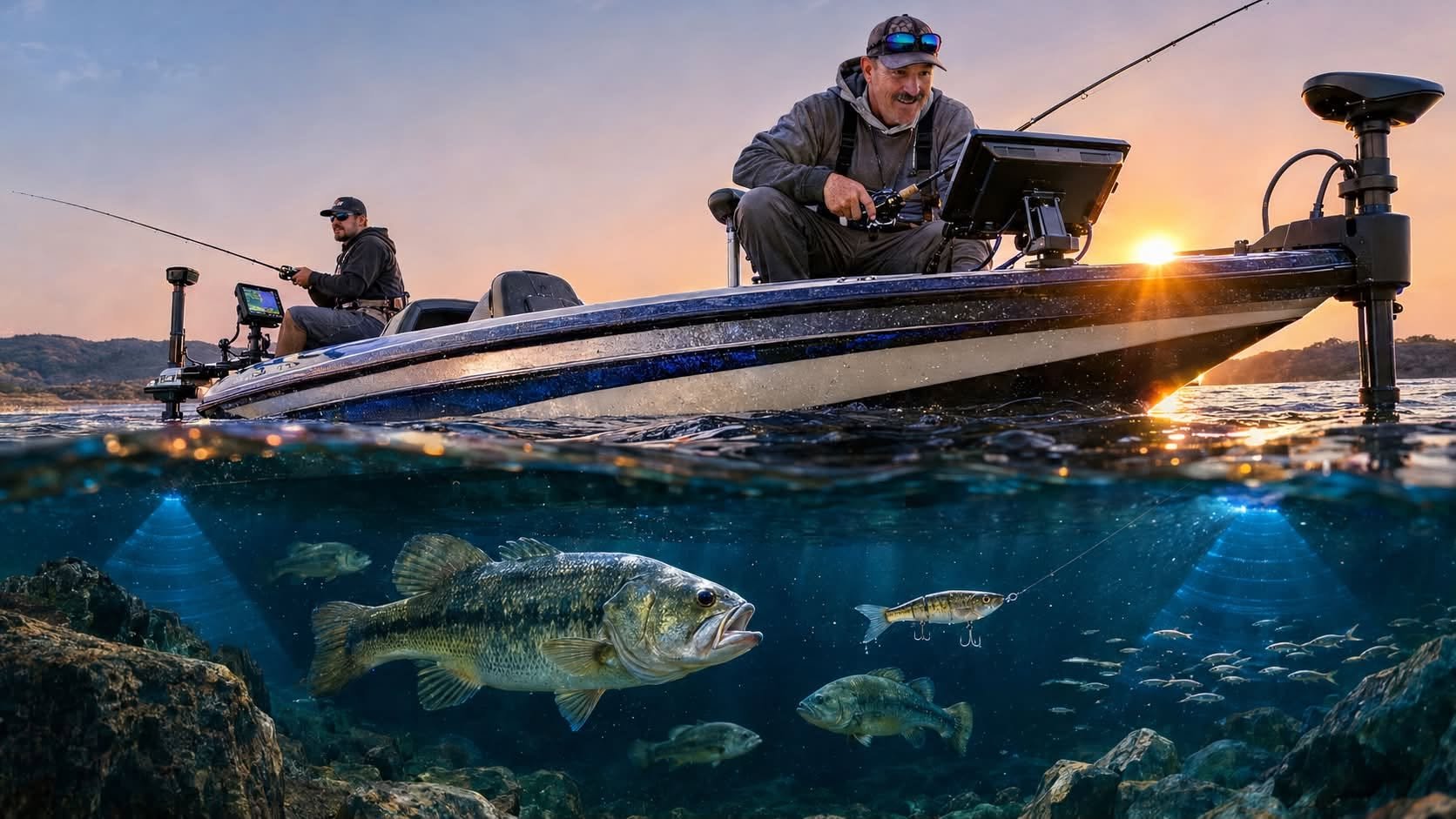
Forward-facing sonar, the soul of fishing, and why fairness shouldn’t stop at the front deck
I went in to get my tires rotated the other day. Before anybody asked about tread wear, alignment, or whether I’d been driving through a field instead of on the road, somebody recognized me.
“Hey, Bill. What do you think about forward-facing sonar?”
I hadn’t even gotten my keys back.
Apparently, a man can’t get his tires rotated anymore without getting his entire fishing philosophy rotated with them.
When I was about 14, my mom told me something that didn’t fully make sense at the time:
“A man convinced against his will is of the same opinion still.”
The older I get, the more I understand it. Politics, religion, fishing—pick your argument. Once people plant their flag, facts alone usually don’t move them. They have to become curious enough to educate themselves, examine both sides, and occasionally admit that the other fellow might not be a complete moron.
That’s a difficult assignment in today’s society. We’ve gotten pretty good at choosing teams and not so good at listening.
So, before we start, let me be clear:
I’m not here to convince you that forward-facing sonar is good or bad.
I’m not handing out halos or pitchforks.
I want to ask a better question.
What do we want fishing to teach us—and what do we want competition to test?
Every Generation Has Its “Cheating”
I’m an old-school angler, but old school doesn’t mean anti-technology.
I remember when a Lowrance paper graph was cutting-edge. You loaded the rolls of paper, went out, marked structure and cover, and watched the machine draw its little electronic confession about what was below you. Before that, the green-box flashers were the magic.
Then came better 2D sonar, down imaging, side imaging, 360 imaging, mapping, GPS—and now forward-facing sonar, which lets you watch fish and your lure in real time.
Every step gave anglers information they didn’t have before.
And every step changed what people considered “real fishing.”
The same arguments show up with lures and techniques. Big Baits and swimbaits were going to make catching big bass too easy.
The Alabama rig was cheating and would supposedly wipe out every impoundment east of Arizona.
Finesse fishermen with light line and “fairy wands” were laughed at—right up until everybody had three spinning rods on the front deck.
Flipping got the same treatment. Dee Thomas and Dave Gliebe helped turn a California Delta technique into a national revolution, but not before competitors complained, demanded rod-length restrictions, and accused them of being unsportsmanlike.
Now a flipping stick is about as controversial as a pair of pliers.
That doesn’t mean every new tool is automatically good. It means new doesn’t automatically mean wrong, either.
Sometimes yesterday’s cheating becomes tomorrow’s standard equipment. And sometimes tomorrow’s standard equipment still needs a rulebook.
I Had Forward-Facing Sight Before I Had Forward-Facing Sonar
Long before live sonar, I was already fascinated by suspended fish, open-water predators, lure movement, and what triggered a big bass to commit.
When I was learning big baits, I had what I call forward-facing sight.
I couldn’t see an actual fish on a screen 40 feet in front of me. But through clear water, experience, lure design, suspended animation, and thousands of hours watching how big bass reacted, I tried to visualize what was happening below the surface.
Mike Jones, who worked with me on the original book The Big Bass Zone, made that connection when forward-facing sonar arrived. So much of what anglers were suddenly watching on their screens was what we had spent years trying to imagine with swimbaits and big baits: positioning, suspended movement, approach angles, hesitation, and reaction.
That’s the foundation of the BBZ philosophy and my updated Big Bass Zone work: stop looking at fishing only through your own eyes and start trying to see through the fish’s eyes.
Forward-facing sonar can help teach that. Watching a bass follow, turn away, rise, sink, or ignore a lure can reveal things that years of guessing might not.
But here’s the distinction: the screen can show you a reaction. It cannot, by itself, give you a complete education.
You still have to understand why the fish was there, why it refused one presentation, and why another angle, speed, color, or fall rate changed its mind.
Information is valuable. Interpretation is where the fisherman comes in.
The Study That Should Make Both Sides Less Smug
One of the laziest claims in this debate is that forward-facing sonar is a magic fish-catching machine.
A 2026 randomized controlled experiment on Wisconsin’s Nebish Lake offers a useful bucket of cold water for that argument. After 512 hours of fishing and 1,722 smallmouth bass, the teams using forward-facing sonar actually caught fewer fish—about 2.5 fewer per day—although the fish they caught averaged slightly less than an inch longer.
The researchers observed that anglers using the technology spent more time searching and targeting individual fish, which meant less time with a lure actually fishing.
One lake, one species, and one summer does not settle every tournament argument or fisheries-management question. It certainly doesn’t measure what the best professional anglers in the world can do with the technology.
But it does expose something important: looking at fish and catching fish are not the same job.
Sometimes the guy staring at the screen would catch more if he quit window-shopping and made another cast.
So no, forward-facing sonar isn’t automatically a magic wand. And no, refusing to use it doesn’t automatically make somebody a purer angler. Both sides can put those particular slogans back in the truck.
Why I Restricted It in the Big Bass Zone Junior Championship
My position makes a lot more sense when you understand what I did with the Big Bass Zone Junior Championship from 2019 through 2021.
I had fished the Big Bass World Championship back in the early 1990s, and years later I had the opportunity to help build something for young anglers alongside Brad Uhl.
We brought kids together from different states, used an app for length-and-girth measurements, and created opportunities for state winners to advance to special championship destinations.
The prizes were life-changing for a young fisherman: opportunities that included a Bass Cat Boats, a $35,000 Bethel University scholarship, sponsor prizes, and incredible fishing trips.
But when we wrote the rules, forward-facing sonar was not part of the competition.
That was not an anti-technology statement.
It was a fairness decision.
Some of those kids had nice boats and strong financial support. Others were qualifying from the bank, a pond, a kayak, or a float tube. Our volunteer boaters also had dramatically different equipment. Some had advanced electronics; others basically had a boat, an outboard, and a trolling motor.
If one young angler received access to expensive live-sonar equipment while another didn’t, we wouldn’t simply be measuring fishing ability. We’d be measuring which kid had access to the bigger wallet.
We used traditional electronics at the bow, with comparable conventional handheld electronics allowed in the back.
The idea was to keep the competition as equal as we reasonably could across different boats and different financial circumstances.
There was a second reason, too.
I wanted those kids to learn what to do when technology doesn’t save them.
Batteries die. Screens glitch.
Transducers get damaged. Electronic scales malfunction. It doesn’t matter whether it’s a graph, a scale, or some future pair of glasses that shows you bass while you’re driving down the lake: eventually, technology will fail you at the worst possible moment.
And when it does, somebody is going to ask the oldest question in fishing:
“Okay, now what?”
Seeing Through the Lure
When I was growing up, fishing the shores of Lower Castaic or riding in an aluminum boat with my dad on the upper lake, my depth finder was often a crankbait, a jig, or a swimbait.
That’s where my ROF—rate of fall—system came from.
If you understand approximately how fast your bait falls on a slack line, you can count it down and estimate depth. If it falls roughly one foot per second and takes around 20 seconds to reach bottom, you have a workable picture of what’s below you.
Then the education really begins.
A jig transmitting through a rod can tell you rock from mud, grass from sand, a hard edge from a soft transition. You begin to understand top, middle, and bottom. You learn casting angles, shadows, current, wind, lure speed, and where your bait is in the water column without waiting for a screen to explain it.
You can close your eyes and start seeing through the lure.
That doesn’t make electronics inferior. It makes your senses worth developing alongside them.
I still fish tournaments at times with my graphs turned off. I still catch fish and have won events that way. That’s my choice, not a badge I’m demanding everybody else wear.
But if you only know how to target visible fish in open water, what happens when the tournament moves into skinny, muddy water filled with tules, brush, grass, mud lines, and shallow cover?
What happens when the winning pattern is flipping, pitching, frogs, or reading barely visible changes along a bank?
At that point, live sonar may be about as useful as a screen door on a submarine.
That isn’t an insult. It’s simply a limitation—just as refusing to understand electronics is a limitation.
The complete angler works on both.
The Magic Was Not Knowing
Fishing is different from most sports because your competitor is hidden.
In golf, you know the distance to the hole. In football, you can see the defense move. In baseball, basketball, and soccer, the opponent is right there in front of you. You react to visible movement.
In fishing, most of the contest happens against something you cannot see.
You have eight hours to solve a living puzzle: seasonal patterns, momentary shifts, wind, current, baitfish, water clarity, temperature, thermoclines, depth, structure, cover, angles, and rate of fall. You build a theory, make a cast, and wait for the underwater world to grade your homework.
That mystery was a huge part of why I fell in love with fishing.
I still think about Larry Nixon’s famous 10-pound bass during the 1988 B.A.S.S. MegaBucks event on Little Lake Harris. He connected with the fish on camera, it erupted from the water, and Nixon delivered the perfectly human reaction: “Oh my gosh, look at the size of that bass.” The moment became a fan favorite.
Part of that drama was the explosion of something unexpected.
The cast was made. The bait was working. Nobody in the boat knew exactly what was about to happen—and then the lake opened up.
Forward-facing sonar changes that experience. Instead of asking only, “Where should the fish be?” you can ask, “There’s the fish—what will it do?”
That second question still requires skill. Anyone who thinks seeing a bass guarantees catching it has not spent enough time being rejected by one in high definition.
But the sport has changed. You are now reacting to a visible opponent more often, much like athletes in other sports.
That isn’t automatically worse.
It is different—and we should be honest enough to discuss what that difference means.
Don’t Confuse a Young Angler’s Mastery With a Lack of Skill
I also don’t want this conversation turning into an excuse to take shots at young anglers who became exceptional with electronics.
If it were easy, everybody using the same equipment would win.
Everybody doesn’t.
Look at an angler like Trey McKinney Fishing. People can criticize the technology all they want, but dismissing his work ethic says more about the critic than it does about him.
The kid put in enormous time on the water learning something complicated while plenty of other people were busy complaining about it.
And in 2026, with the Elite Series split between FFS and non-FFS events, McKinney won Angler of the Year. He estimated that he fishes at least 200 days a year. That sounds a lot like time on the water and dedication, not a kid pushing a button marked “catch bass.”

That should end the lazy asterisk.
Time on the water matters. Perfect practice matters. Learning from the right people matters. The best electronics anglers are usually not replacing fishing knowledge; they are stacking another skill on top of it.
The older generation shouldn’t throw rocks at a young angler because he learned a new language quickly. And the younger generation shouldn’t laugh at the old guy who can feel a rock pile through a jig.
When the battery dies, that old guy may suddenly become pretty good company.
The Person in the Back of the Boat
My biggest concern with forward-facing sonar isn’t simply what it does to fishing.
It’s what it can do to the other fisherman in the boat.
One of the great things about the old pro-and-co-angler format was that you could learn from each other. You might be on the Columbia River convinced you were on the winning pattern, only to have the co-angler in the back pick up a crankbait or spinnerbait and put a whooping on you.
That wasn’t a bad day. That was a floating classroom.
Anglers used to show up with a new soft-plastic bait hidden in a paper bag because they didn’t want everybody seeing it. Somebody would catch fish on a Sluggo or Senko-style bait, other anglers would start asking questions, and a technique would spread.
Now imagine the co-angler spending the day behind a pro who is locating individual fish, positioning the boat, watching the screen, and making precise presentations to targets the person in the back cannot see.
What exactly is that co-angler learning?
Too often, the back of the boat risks becoming a seat for an unpaid witness to somebody else’s video game.
That is not good for participation, education, or the future of tournament fishing.
Put a Second Station in the Back
Here’s the idea I want people to chew on—not just react to in the comments before they finish reading:
If a tournament boat is going to be a two-angler forward-facing-sonar boat, why not make it a two-station forward-facing-sonar boat?
Instead of mounting live sonar only on the trolling motor at the bow, develop a safe, deployable rotating arm or drop-down pole for the rear of the boat.
Give the co-angler a dedicated display and an independently controlled transducer that can scan behind and around the stern.
The fish don’t know which end of the boat is the front.
The pro can search and fish from the bow. The co-angler can search and fish from the stern. Each person gets to locate targets, make presentations, watch reactions, and learn.
The rear unit would be controlled by the co-angler—not simply become a second scouting screen for the pro. It could deploy only while fishing, with standardized safeguards so it doesn’t interfere with the outboard, shallow-water anchors, or safe boat operation.
If somebody can justify spending $20,000 or $25,000 outfitting a boat with electronics, perhaps the industry can justify a serious conversation about what a few more thousand dollars would mean for keeping two anglers actively involved.
This doesn’t have to mean forcing every co-angler to use the technology. If the person in the back wants to turn it off and throw a spinnerbait, wonderful. That’s their decision.
Equality doesn’t mean forcing everybody to fish the same way. It means not denying somebody an opportunity because of where they happened to sit.
The major leagues are already experimenting with compromise. In 2026, B.A.S.S. allowed FFS at five of nine Elite Series events and prohibited it at four, including during official practice at those non-FFS tournaments.
Major League Fishing limited Bass Pro Tour anglers to one declared period of FFS or 360 use per day. In its Toyota Series and BFL formats, MLF also created windows in which co-anglers may use portable forward-facing sonar.
That co-angler provision acknowledges the problem. My question takes it one step further:
Is merely permitting somebody to bring technology the same as giving both anglers a meaningful opportunity to use it?
A standardized, properly engineered rear station could move us closer to actual equality.
If organizations want healthy co-angler participation, they need to protect the experience of the people helping fill those fields. If participation declines, the money has to come from somewhere, which could eventually mean higher entry costs or membership expenses for the pros.
That’s not a threat. That’s arithmetic.
Let the Best Anglers Prove They’re the Best
As a fan, I want to watch the best anglers in the world demonstrate the full range of what fishing demands.
I love the era of Kevin VanDam, Rick Clunn, Hank Parker, Bill Dance, Larry Nixon, and so many others who seemed to possess a sixth sense. They understood seasonal movement, changing conditions, bait, wind, current, and the little voice that says, “Something’s different. I need to go check that other area.”
I also appreciate what today’s anglers can do with modern electronics.
So why does every event have to prove only one philosophy?
Mixed schedules, limited technology windows, seasonal applications, and traditional-only tournaments all ask different questions. Used thoughtfully, they can reward the complete angler rather than turning every championship into a referendum on one tool.
The best angler with forward-facing sonar should be able to catch them.
The best angler without it should be able to catch them.
And the best angler, period, should be able to adapt when either approach stops working.
That’s the competitor I want to watch.
When the Screen Goes Dark
So, is forward-facing sonar good or bad?
I’m not crowning it, and I’m not hanging it.
If it helps you catch fish, learn behavior, and enjoy your time on the water, that’s your choice. If you prefer turning everything off and fishing by instinct, angles, feel, and experience, that’s your choice too.
But learning something doesn’t require worshipping it.
An old-school angler can learn forward-facing sonar without using it in every tournament. Watching fish respond might improve his swimbait, jig, crankbait, or finesse presentation. It may give him a better understanding of what he had only imagined before.
By the same token, a screen-first angler can learn rate of fall, bottom composition, seasonal movement, shallow-water cover, and how to fish when there is no electronic target to chase.
That exchange would make both fishermen better.
Technology should add a skill, not delete one. A clearer picture should not be mistaken for a complete education. And fairness should not stop at the front deck.
My mom was right: a man convinced against his will is usually going to keep his original opinion. So I’m not trying to drag anybody across the line.
I’m just suggesting that we spend less time trying to win the argument and more time learning from what the other side knows.
Use the tools you believe in.
Respect the angler who chooses differently. Keep enough fundamentals to continue fishing when the tools quit.
And every once in a while, turn off the screen, make a cast into water you cannot see, and remember what it feels like when the answer comes up through the rod.
That little jolt of not knowing?
Double-click to edit...