Nov 12 Written by Bill Siemantel
Anatomy of a champion: the Puma is the skeleton. The Mercury Pro XS 250 is the legs and shoes. The Ghost X is the stamina. The Lowrance HDS PRO stack is the eyes. The Power-Poles are the feet that hold me still. The Bob's jack plate is the knees. The LithiumPros are the heartbeat. And Russell Marine? They're the surgeons. Welcome to the anatomy lesson.
PART 2 — The Skeleton: Building the 2027 BassCat Puma
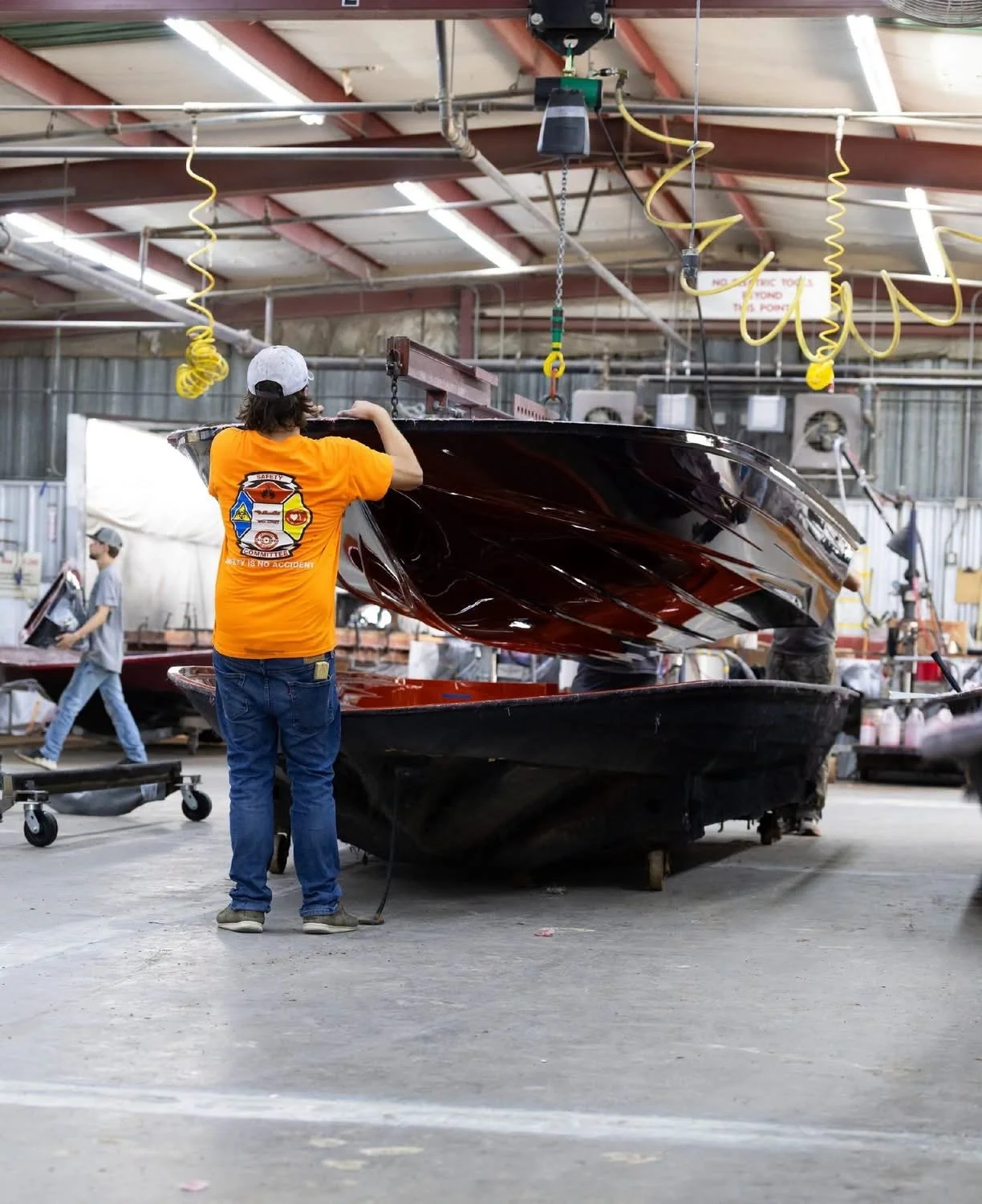
Straight off the factory floor in Mountain Home — word from inside BassCat is that the bottom hull of MY 2027 Puma is finished, and the War Wagon is officially growing from the bottom up]
Part 1 was the soul. Part 2 is the skeleton. On November 9, my 2027 BassCat Puma started its life on the factory floor in Mountain Home, Arkansas — the same town where this whole story began for me in 2000. I like that. Full circle looks good on a boat.
And now the update that just came over the transom. That photo above is the real thing, hot off the production line — and if the rumors rolling out of Mountain Home are true, you're looking at the bottom hull of the actual War Wagon. Done. Cured. Gleaming. That's how a BassCat is born: from the bottom up. The running surface comes first, because that's the part that takes the beating for the next twenty years — the foam-filled stringer system, the all-fiberglass hull, the vinyl ester skin, all of it built as one unit. I spent 34 years watching buildings go up around Los Angeles, and I can tell you nobody hangs drywall before they pour the slab. Boats are no different. The spine comes first, and everything else hangs on it.
Why the Puma? Simple — my office needs legs that go anywhere. The new Puma stretches 20 feet 7 inches with a 96-inch beam, carries 64 gallons of fuel, and runs up to a 300-horse rating. Translation: range and economy. I want to chase giant smallmouth in Idaho, compete in California tournaments, and run next year's U.S. Open at Lake Mead — from the same office, without compromise. The Puma is the only skeleton that checks every box.
Now a quick anatomy flashback, because this skeleton has a bloodline. In 1971, Ron and Jan Pierce started building boats in a two-car garage in Mountain Home. The first BassCats sold for under a thousand bucks — boat, motor, and trailer for less than $2,500. By 1972 they'd outgrown the garage and moved into the same factory where my Puma is being laid up right now. And here's what most people don't know: half the "standard features" on every modern bass boat were born in that building. Recessed trolling motor pedals? BassCat. Elevated electronics? BassCat. Onboard battery chargers, lighted storage boxes? BassCat. While other builders were literally screwing boats together in the mid-'70s, the Pierces refused — every Cat leaves the mold as one piece, because nobody should have to re-tighten their boat after a long day on the water. In 1984 the Pantera Pro became the industry's first 19-foot, 200-horse, wide-beam bass boat. In 1988 the Pantera II and Sabre invented the modern tournament machine. And BassCat flat-out calls the Puma the most innovative tournament hull it's built since. Ron Pierce — who spent a decade as the mayor of Mountain Home and chaired the Arkansas Game and Fish Commission when he wasn't building boats — passed away in 2016 at 81, and his son Rick carries the torch today. That's not a company. That's a family. The BCB Family. And in 2000, a firefighter from California bought his way into it.
This build wouldn't be happening without two phone calls. Calling around, talking to Rick Pierce — and the rep I've dealt with for years, Daylon Owens at BassCat. Things have changed over the years: BassCat builds the finest hulls on earth, and then they pointed me toward the crew that finishes the elite-level rigs — but more on the surgeons in Part 7.
Here's what 27 years of BassCat ownership has taught me: the skeleton matters more than the paint. I've jumped into pretty much every boat on the market at Bassmaster Invitationals over the years — Rangers, ProCrafts, Skeeters, Tritons, you name it. I've driven the whole menu. I keep coming back to the Cat because of what happens when 700 + teams are charging across Norfork, or when an six-pound smallmouth in Idaho tests your hull in three-foot chop. Some boats are built to look good at the dock. BassCats are built to come home with hardware.
The bottom hull is done. The welders are fired up, the fiberglass is curing, and the War Wagon is getting her skeleton — from the keel up, the way Ron and Jan did it in the garage. Next stop after Mountain Home: surgery. #BBZWarWagon
Double-click to edit...