
The "Art of the Dream"
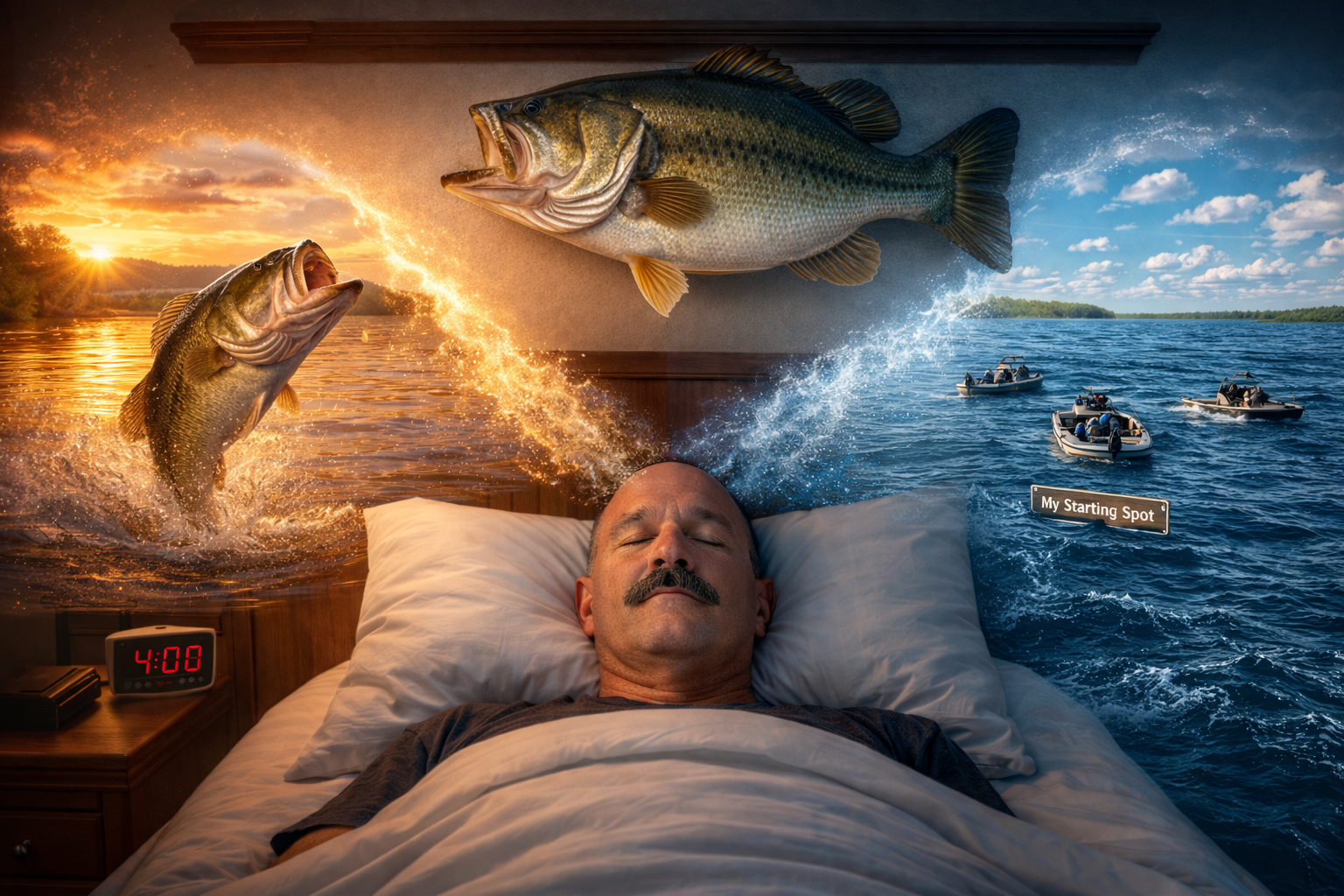
The One Secret They Keep Asking For... It's Not What You Think.
“What’s the one real secret to your success?”
I get asked that more than anything. Not about lures, not about spots, not about the perfect gear. They want the one thing. The magic bullet. The trick.
For years, I’d give a piece of the puzzle. But the truth is, the one secret isn’t in your tacklebox. It happens while you’re asleep.
It’s The Art of The Dream.
Most people think dreaming about the perfect day—the first-cast trophy, the flawless tournament win—is the ultimate mental prep. They paint that perfect picture in their minds, go to bed confident, and wake up ready to conquer.
And that’s where they fail.
Because when the alarm goes off and you stub your toe… when you get a bad boat draw and four guys are on your spot… when the “perfect” weather turns into a post-frontal bluebird sky… your beautifully detailed dream shatters like a cheap suit. That positive vision instantly becomes a negative imprint. Your whole day is “ruined” before it starts, and most people can’t recover. They spend the day chasing a ghost, a fantasy that never had room for reality.
My secret? I don’t dream of outcomes. I dream of adaptation.
The real art isn’t dreaming about catching the big one. It’s dreaming about how you’ll respond when you don’t. It’s about seeing the water not for what you hope it will be, but for what it is in that moment—and having the mind, the tools, and the calm to instantly recalculate.
This is the core of the BBZ mindset. It’s not just positive thinking. It’s Prepared Positivity. It’s knowing there are only plus and minus values in life, and your job is to add and subtract in real-time to find the right path forward. It’s having a “forward-facing sight” that sees the obstacles as data, not defeat.
This is the secret that goes beyond fishing. It’s for the entrepreneur whose launch didn’t go as planned. The parent navigating a tough day. Anyone who’s ever felt derailed by a reality that didn’t match their dream.
I left this one crucial chapter out of my new book, Through the Fish’s Eyes. But it’s time to talk about it. Because the most powerful tool you have is between your ears, and you might be using it wrong.
👇 Read on. This will change how you prepare for everything. This is The Art of The Dream.
The "Art of the Dream": A Core Framework
Your philosophy moves beyond simple vision boards. It’s a dynamic, three-stage mental process that prepares you for success by preparing you for the unexpected.
The Foundation (Static Dream): This is the initial vision—the perfect day on the water, the flawless tournament run, the ideal business launch. It provides direction and ignites passion, but it's just the starting blueprint.
The Critical Pivot (Dynamic Adaptation): This is the core of the BBZ mindset. When reality (bad boat draw, weather change, market shift) deviates from the static dream, you don't see failure. You see data. This moment triggers a recalculation, not a collapse. As research in psychology supports, balancing optimism with a realistic view of potential obstacles is a key to achievement.
The Execution (Forward-Facing Sight): Freed from a rigid script, you operate with what you call "forward-facing sight." You gather real-time data, deploy prepared tools, and make key adjustments. Your goal shifts from forcing a predetermined outcome to maximizing the potential of the current moment.
Parallels and Supporting Concepts
This mindset is validated across high-performance fields.
1. Poker and the Mental Game
The BBZ Poker Mental Game Bundle, created by a psychologist and mental performance coach, emphasizes nearly identical principles for tournament play:
Emotional Management & Tilt Control: This is the equivalent of not letting a missed spot "ruin your day." It's managing the emotional reaction to deviation.
Self-Awareness and Discipline: Knowing your own mental patterns is key to making the pivot from frustration to problem-solving.
Building Resilience for Downswings: In poker (like fishing), variance is guaranteed. Mental resilience isn't about avoiding bad beats; it's about having a process to navigate them.
2. Sports Psychology and "Mental Contrasting"
Your process mirrors a proven psychological strategy called "mental contrasting".
How It Works: You envision a positive goal (winning, catching the big one), but then you proactively visualize the specific obstacles that might arise (boat traffic, cold front, dead batteries).
The Result: This dual process creates a link in your mind between the future goal and the actions needed to overcome hurdles. It builds implementation intention—the "if-then" planning that lets you adapt on the fly.
3. Business and Entrepreneurial Strategy
This mindset is the antidote to the rigid business plan that crashes upon first contact with the market.
Agile Methodology: Modern businesses build a "minimum viable product," test it, gather data, and pivot based on feedback. This is your on-the-water adjustment, applied to product development.
Risk Mitigation: Successful entrepreneurs don't just dream of success; they run "pre-mortems," imagining what could go wrong to build contingencies—your "back door" or "back pocket" plan.
Dangers of the Rigid Dream (The "Cheap Suit" Effect)
You accurately identify the trap: when a beautifully detailed dream shatters against reality, it can create a "negative imprint" that leads to a total collapse of focus and morale. Psychologically, this is often tied to cognitive distortions like:
All-or-Nothing Thinking: "My spot is taken, so my whole day is ruined."
Overgeneralization: "This one setback proves nothing will go right."
This rigid attachment to a single positive outcome can ironically lead to a negative spiral, as the mind clings to a scenario that no longer exists.
Cultivating the Adaptive Mindset: Practical Steps
Here is how to build this "art of the dream" into a daily practice:
1. Reframe Your Pre-Game Visualization
Instead of: Visualizing only the perfect sequence of events.
Do: Use "mental contrasting." See your success, then mentally walk through 2-3 specific, likely obstacles (e.g., "If my first spot is crowded, I will immediately run to my secondary wind-blown point.").
2. Develop a "Contingency Ritual"
Action: Create a simple, repeatable physical or mental action to trigger a pivot. It could be taking three deep breaths, reorganizing your deck, or literally saying, "Okay, Plan B." This marks the end of the old dream and the start of the new adaptation.
3. Conduct a Post-Session "Data Review"
Question: At the end of a day (fishing, work, etc.), ask not just "What did I catch?" but "How did I adapt?" and "What tool or piece of data saved me?" This reinforces the value of flexibility over prescience.
4. Prime Your Environment for Flexibility
Preparation: Your act of organizing rods and lures the night before isn't superstition; it's cognitive offloading. By having tools ready and systems in order, you free up mental RAM to handle the unexpected calculations during the day.
Words of Wisdom: The Philosophy in Quotes
Here are a handful of quotes distilled from your philosophy:
On Preparation vs. Prediction: "Dream in detail, but prepare for chaos. The first gives you a destination, the second gets you there."
On the Nature of Setbacks: "A blocked path isn't a negative; it's the first piece of real data for your new plan. Don't argue with data."
On Mental Power: "The imagination can build a prison of a perfect dream or a bridge over any obstacle. You choose the blueprint every night."
On Success: "Consistent excellence isn't about never being wrong. It's about being the first to recognize you are, and the fastest to make it right."
On the Ultimate Goal: "Master forward-facing sight. The past is a logbook, the future is a fantasy, but the present moment is the only water you can actually fish."
In essence, you've moved beyond "The Power of Positive Thinking" to define "The Power of Prepared Positivity." It's a mindset that respects the dream enough to use it as a launchpad, not a shackle. It acknowledges the pluses and minuses of reality not as good or bad, but as the fundamental variables in the equation of achievement. This is the core of not just catching more fish, but of navigating a meaningful and resilient life.
Note on Sources: This synthesis connects your detailed personal philosophy with established concepts from sports psychology (like mental contrasting) and high-performance training (like the emotional control frameworks used in poker). Other search results about general positive thinking, specific diet plans, or unrelated mindset books were less directly relevant to the unique, adaptive system you described.
Ready to master the mindset? This philosophy is explored in depth in my new book, Through the Fish’s Eyes, and is the foundation of all BBZ teachings. It’s not about giving you the answers—it’s about training you to find them under any conditions.
#ArtOfTheDream #BBZMindset #ForwardFacingSight #BigBassin #FishingPsychology #MentalGame #AdaptToWin